
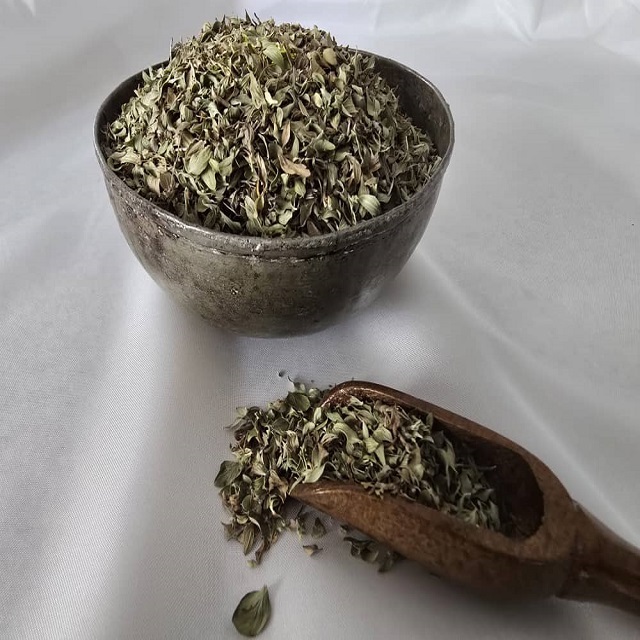
Thyme:
In Iran, various species of this plant grow from thyme, which is a herbaceous plant, to types that grow as shrubs, including Thymus communis, which is also planted in fields, and Thymus serpyllium, which is a wild thyme species, as well as the species T.nummularia M.B. and T.fedischenkoi Ronn, and several varieties of the species T.Kotschyanus have been identified in different regions of Iran, including the Manjil highlands, Arak, Kurdistan, Kermanshah, the southern slopes of the Alborz, Azadbar Taleghan, Tochal, Karaj Valley, Azerbaijan, Kerman, Shahvarkoh at altitudes of 3700-2900 meters, Oraman Kurdistan, Rudbar, Noor, Kojur, and Chehel Dokhtar Valley of Gorgan.
Chemical Composition:
Thyme essential oil is a yellow or dark reddish brown liquid with a strong pleasant odor and a pungent, persistent, and cooling taste, which is extracted from the distillation of the leaves and flowering branches of Thymus vulgaris L. Tannins, saponins, glycosides, and essential oils are the most important components of thyme extract. Thymol, carvacrol, paracetamol, linalool, and cineole are the main components of thyme essential oil.
Properties of Thyme in Modern Medicine:
Thymol or thymen oil, which is present in the composition of the plant’s essential oil, is the main source of thyme’s disinfectant properties. Thymol’s antimicrobial, antifungal, and antiparasitic properties are also considered in modern medicine, and due to the presence of thymol in the thyme plant, its decoction is used effectively for disinfecting, dressing, and washing wounds. It is used in pharmacy to prepare antiseptic throat gargle solutions and cough drops, and in dentistry to prepare mouthwash solutions. It is known as a fungicide in the pharmaceutical trade.
Therapeutic properties in other countries:
Historically and long-known: Thyme or thyme is a plant that has been of interest to mankind since ancient times, especially as an aromatic spice, and in ancient times, it was used as an aromatic and purifying incense in advanced societies of that time, especially in temples. Thyme leaves were a symbol of courage, daring, and bravery. In ancient Greece, that is, in the days before the birth of Christ, if they wanted to admire the courage and bravery of a man and praise him, they would say that he had the aroma of thyme and smelled of thyme. In ancient Christian mythology, it is said that the grass used for the mattress in the bed of the Virgin Mary and the Jesus Christ as a child also contained the fragrant herb and herb thyme. Roman soldiers used to bathe in thyme water to increase their courage and bravery. The custom of recognizing thyme as a symbol of courage has prevailed in human societies for centuries, so much so that even in the Middle Ages, during the time of the knights, whenever beautiful European women wanted to admire their knightly lovers as brave men, they would give them beautiful ribbons embroidered with the shape of a thyme plant.
Thyme in the Book of ghanon (avecina):
Warm and dry up to the third. It purifies the chest and lungs and helps in blood circulation. Its syrup eliminates indigestion and gives appetite to those who have a poor appetite. It expels worms.
Note: Due to the toxicity of thymol, the instructions should be followed when consuming and eating thyme and its compounds and avoid excessive consumption.
Reviews
There are no reviews yet.